
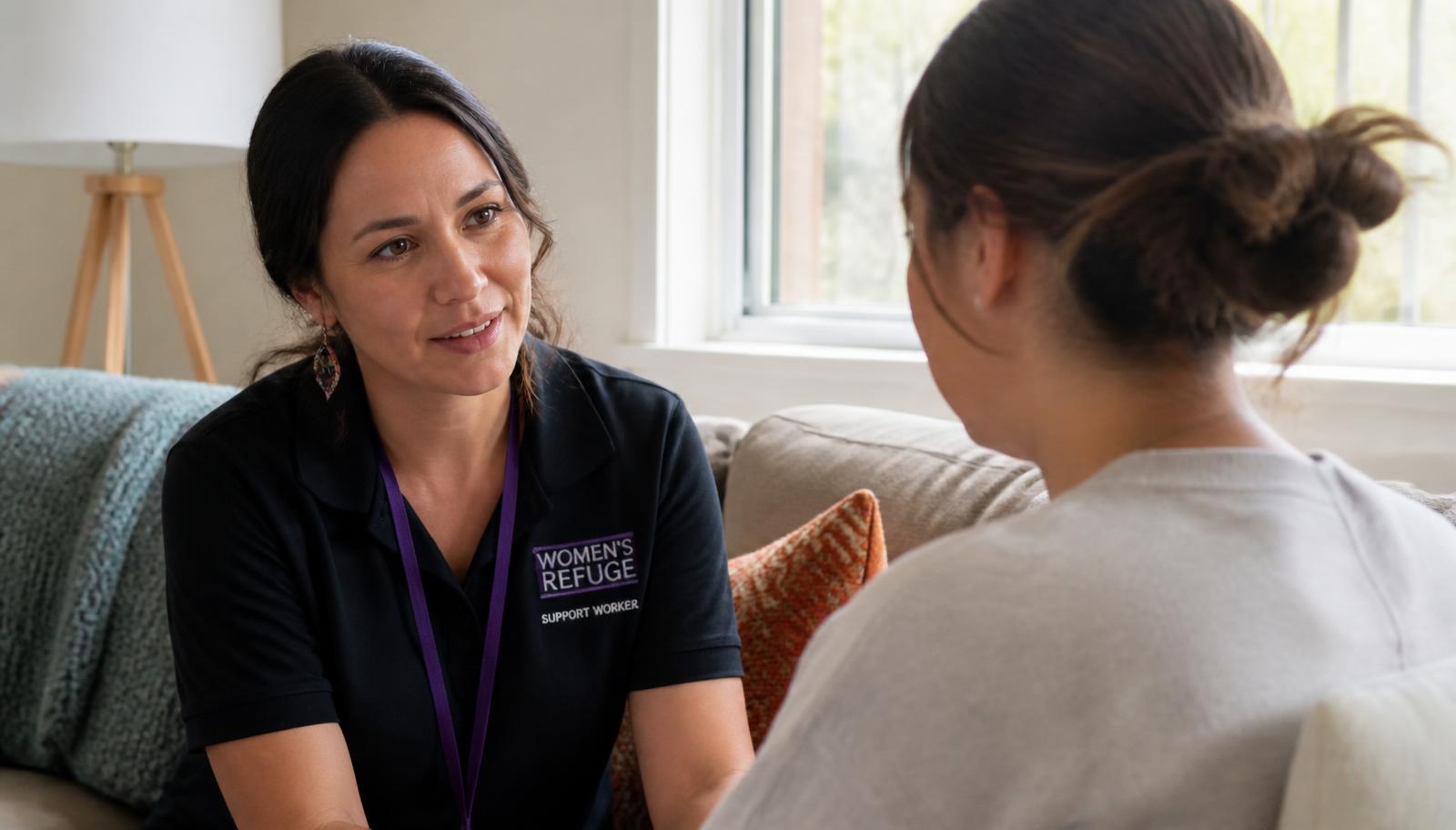
A record built to protect first, and to help because it protects.
Reaching a specialist family violence service is often the hardest phone call someone will ever make, and the record that follows has to earn that trust from the very first field it asks for.
Konetic One holds risk assessment, safety planning, refuge and outreach, court support and lawful information sharing on one platform, where the address, the alias and the access rule are treated as safety controls, not settings someone forgot to change.

Who this is for
A safe space starts at the front desk, and it has to hold once someone is inside.
A specialist family violence service is a place someone reaches after a decision that took courage, often on a bad day. Everything after this page is about making sure the record behind that desk never becomes the reason a person is found.
- Address, alias and contact controls applied from the first contact
- Risk assessment started at the desk, carried into the case
- Children recorded as clients in their own right, not as notes on a parent
Why this record is different
Every other sector's record makes information easier to find. This one has to make some information harder to find, on purpose.
A case management platform generally exists to reduce friction, so a worker can see everything relevant to a client without searching multiple systems. In domestic and family violence work, that same instinct is dangerous if applied without limits. A shared family record, a broad search function, or a default setting that surfaces a client's current address to any staff member with system access, can turn a convenience feature into the reason a person is found.
Konetic One is built on the position that safety controls are not an add on to a generic case management system. They are load bearing. Address masking, alias handling, conflict of interest blocking and a quick exit control are treated with the same rigour as risk assessment and safety planning, because a record that gets those things right but leaves the address field open has not actually protected anyone.
Signature module
The risk escalation spine.
A risk level that only exists inside a completed assessment form protects nobody. Move the level below and see what actually happens in the platform as a client's recorded risk changes, independent of which jurisdiction's framework produced the level.
Recorded risk level
Arrow keys move the level up and down.
Current risk level and safety flags promoted to the client banner and any after hours worklist, multi agency information sharing considered under the relevant scheme, safety plan escalated to include quick exit and refuge options.
- Client banner shows current level to every authorised worker
- After hours and on call worklist includes the client
- Information sharing register open if a disclosure is made
Address suppression, not an afterthought
Any physical address tied to a client, a refuge property, a school pickup point or a new residence, is masked by default and visible only to workers explicitly authorised against that specific address. Every view is logged with the worker's identity and the time.
What it replaces
You cannot say with confidence who has viewed a high risk client's file, or whether a flagged person could reach it.
Conflict of interest flags block a named party from ever surfacing another client in search, and every view of a restricted record is logged with who looked, when and from where.
How it plays out, a risk level moves to high
A client's ex-partner has located her new suburb and made contact through a mutual friend.
Record the new information
The disclosure is logged against the risk assessment, and the framework's own indicators flag the change as significant rather than routine.
Trigger the out of cycle review
Risk level recalculates to high, and the client's banner updates for every worker authorised on the file.
Escalate the safety plan
Quick exit and refuge options move to the front of the plan, and the after hours worklist is updated to include this client automatically.
Consider an information sharing disclosure
The decision, the legal basis under the relevant scheme and the recipient are recorded on the disclosure register attached to the client file.
The change in risk moved from a phone call and a spreadsheet edit to a same day reassessment with every step, and every disclosure, on the one auditable file.
Baseline
No current escalation indicators recorded
Standard case management, scheduled risk review on the framework's own cadence, safety plan current and accessible to every worker authorised on the file.
Risk framework current, Safety plan reviewed on schedule, No open flags
Quick exit, built in from day one. Any client facing surface, the client portal, an SMS reminder, a shared appointment link, is built assuming it may be viewed on a device the client does not fully control. A visible quick exit control clears the screen instantly to an innocuous page, and reminder text is kept deliberately neutral by default.
A client rings to ask what happens next with their DVO, and the worker has to dig through paper to answer. Court dates, DVO conditions, safety plan status and next appointment sit on the current record, so any authorised worker can answer without asking the client to start again.
Elevated concern
A material change has been recorded against the client
Out of cycle risk review triggered automatically, safety plan flagged for revision, case manager notified the same day rather than at the next scheduled contact.
Trigger event logged, Reassessment due within days, not the standard cycle, Supervisor visibility on the caseload dashboard
Alias handling keeps a change of name safe. Where a client is using a changed name or a working alias for safety reasons, the record holds both identities without collapsing them into one field. Correspondence and reminders default to the client's chosen working name, while the underlying identity stays linked for funding, Medicare or legal continuity where that is unavoidable.
Risk assessment lives in one system, safety planning in a document, and case notes in a third. Risk assessment, safety plan and case notes sit on one client record, so the current risk level, the current plan and the last contact are visible in one place, to the workers who are authorised to see them.
High risk
Risk framework has produced a high or serious risk outcome
Current risk level and safety flags promoted to the client banner and any after hours worklist, multi agency information sharing considered under the relevant scheme, safety plan escalated to include quick exit and refuge options.
Client banner shows current level to every authorised worker, After hours and on call worklist includes the client, Information sharing register open if a disclosure is made
Address suppression, not an afterthought. Any physical address tied to a client, a refuge property, a school pickup point or a new residence, is masked by default and visible only to workers explicitly authorised against that specific address. Every view is logged with the worker's identity and the time.
You cannot say with confidence who has viewed a high risk client's file, or whether a flagged person could reach it. Conflict of interest flags block a named party from ever surfacing another client in search, and every view of a restricted record is logged with who looked, when and from where.
Immediate danger
An imminent threat to life or safety has been identified
Direct escalation to emergency services and any pre agreed multi agency response, the safety plan's immediate danger stage actioned, the incident recorded against the client the moment it is safe to do so.
Emergency response pathway, not a routine workflow, Incident logged as soon as it is safe to record it, Post incident review scheduled automatically
Access still defaults to narrow. A perpetrator who is also, in a family or kinship system, a client of another program in the same organisation must never be able to reach information about the person he has harmed. Access is deliberate and logged, not a side effect of a generic permission model.
A men's behaviour change program and the victim support arm of the same organisation both need to know about a client, but never the same things. Program level access controls mean a men's behaviour change worker and a victim survivor case manager can both operate within the one organisation without either side's record being visible to the other, with any deliberate shared safety information logged as an explicit exception.

Where the work happens
A conversation, not an intake form.
Risk assessment and safety planning happen in ordinary rooms, with a worker giving full attention to a person, not to a screen. Konetic One is built so the note can wait until the conversation is finished, illustrative of the pace this work actually needs.
- Worker attention stays on the person, not the form
- Notes and risk flags recorded straight after, not reconstructed later
- A calm room stays calm, regardless of what the record is quietly tracking

Community advocacy
No specialist family violence service works alone.
Police, courts, housing, legal services, community health, children's services and men's behaviour change providers all touch the same family's safety. The information sharing pathway below exists because that coordination has to be lawful and fast at the same time.
- Requests and disclosures recorded against the client with the scheme they were made under
- Every share carries a purpose, an authorised worker and a timestamp
- Partner agencies receive only the fields the purpose justifies
Frameworks and funding
The frameworks a service is already working within.
National Plan to End Violence against Women and Children
Sets the ten year national policy direction, with primary prevention, early intervention, response and recovery, healing as its four domains. Services funded under state and territory action plans that sit beneath it need reporting that maps to these domains.
Risk frameworks, MARAM, CRAF and DVSAT
Victoria's Family Violence Multi Agency Risk Assessment and Management framework, New South Wales's Common Risk and Safety Framework, and the Domestic Violence Safety Assessment Tool used by NSW Police, each set indicator sets, responsibility levels and review cadences that a record has to hold as configuration, not as a single generic form.
Information sharing schemes
Victoria's Family Violence Information Sharing Scheme and Child Information Sharing Scheme, and comparable interagency arrangements elsewhere, authorise disclosure without consent within defined thresholds. The legislative basis for every disclosure needs to be recorded at the point it is made.
State and territory funding and reporting
Specialist family violence services report against state contract schedules, often including SHIP or equivalent data collections, DEX where Commonwealth funded programs are involved, and jurisdiction specific outcome measures tied to risk level and safety planning activity.
What changes with Konetic One
The capabilities behind the controls above.
Access control and audit
Conflict of interest blocking, address masking and full view logging, configured per client and per address rather than as a blanket setting.
ExploreWorkflow automation
Reassessment prompts, out of cycle review triggers and escalation routing tied to the risk framework a service actually uses.
ExploreClient portal
A quick exit control, neutral notification defaults and client editable safety plan detail between formal reviews.
ExploreCommunications
Secure after hours handover, on call worklists and safe channels for interagency information sharing requests.
ExploreCompliance evidence
Disclosure registers mapped to legislative basis, assessment history retained version by version, exportable for a serious incident review.
ExploreAnalytics
Caseload risk distribution, reassessment currency and refuge occupancy reported without a manual data pull.
ExploreThree settings, one record
Refuge, outreach and the office, held together.
A family violence service rarely runs from one building. The same record has to travel between a refuge intake room, a community outreach visit and a duty worker's desk without losing anything on the way.




“A woman should have to tell her story once, to the person who can act on it.”
Illustrative, at a mid sized service
What one record looks like across a caseload of this size.
135 hrs
Admin hours in scope each week
Across your case management workforce, before any change.
2,592 hrs
Hours back each year
Assuming a conservative 40 percent of that admin is duplication a single record removes.
163
Scheduled risk reviews a year
For clients currently held at high risk, based on a typical review cadence.
180
Clients on one protected record
Risk assessment, safety plan and case notes in a single, access controlled file each.
These are indicative and deliberately conservative. We would rather build the model with your real caseload and reporting data in a working session than publish a number that flatters us.
Ruby notices what a busy worker cannot hold in their head, quietly.
Ruby lives underneath the record like a nervous system, not a control tower. It notices when a risk level has gone stale against its own review cadence, when a safety plan has not been touched since a client changed address, or when a partner contact note conflicts with what a participant has reported, and it surfaces that quietly to the worker who can act, rather than shouting an alert at everyone. It never makes the judgement call itself, and it never appears where a client, a perpetrator or an unauthorised worker could see it.
Sector operating brief
Running a family violence service inside a system built on disclosure risk.
Risk assessment and safety planning frameworks
Victoria's Family Violence Multi Agency Risk Assessment and Management framework, New South Wales's Common Risk and Safety Framework and the Domestic Violence Safety Assessment Tool each set their own indicator sets, responsibility levels and review cadences. A service running more than one jurisdiction's funding cannot force all of that into a single generic form without losing the specificity a framework is meant to provide. Konetic One configures each framework as its own indicator set and review cadence through the framework engine.
Refuge and crisis accommodation operations
A refuge's physical location is itself a safety control, and occupancy still has to be managed like any other accommodation service, vacancy, bed turnover, hold periods and exit planning, without the address appearing on a report, an export or a referral document by accident. An after hours worker taking a crisis referral can open a minimal, safety focused intake with the client's working name only, confirm a bed, and hand over to the day team without a single phone call, because the day case manager opens the same file the after hours worker left. Konetic One treats every property as a live, access controlled record through assets and inventory.
Court support and legal matters
A client with a Family Violence Intervention Order hearing needs a straight answer on the current conditions, the hearing date and her legal aid referral status the first time she calls, not after a court support worker has checked a paper diary and a separate referral note. When an order is granted with amended conditions, the updated conditions replace the prior version on the record and the safety plan is flagged for review against them, with any downstream notification, such as a change to a school pickup arrangement, logged on the disclosure register under the relevant information sharing basis.
Perpetrator interventions
Men's behaviour change and other perpetrator intervention programs need their own enrolment, attendance and outcome tracking, run by workers who may sit in the same organisation, sometimes the same building, as the service supporting the person that participant has harmed. Getting that separation wrong is not a privacy inconvenience, it is a safety failure. Konetic One's conflict of interest flags stop that record from ever surfacing in the other party's search through workflows.
Strict record confidentiality
A specialist family violence service usually operates within a larger organisation running other programs, and a generic case management permission model that grants broad access by default is a genuine risk. Access has to default to narrow, with any exception, such as a joint family service viewing a shared child's record, deliberate and logged. Konetic One's role and program level access controls, described through compliance, are built on that default.

Hands and gestures of support
Support looks like someone staying in the room.
A hand on the table, a moment of quiet, a next step written down together. The gestures that make a family violence service feel safe are small and human, and the record's only job is to stay out of their way while holding what needs to be held.
Platform capability map
What a family violence service must do, and how the platform does it.
| What this sector must do | How Konetic One does it | Feature |
|---|---|---|
| Run structured risk assessment and safety planning | Risk screens, review triggers and safety plans sit on the client record with escalation rules that fire when risk moves. | View |
| Share information lawfully under state schemes | Prescribed entity sharing is logged with purpose, recipient and consent position, so a disclosure can be justified later. | View |
| Keep location and property details protected | Refuge addresses and property records are access controlled and excluded from general exports and referral documents. | View |
| Separate victim survivor and perpetrator records | Conflict of interest flags block cross access between programs inside the same organisation and log every attempt. | View |
| Staff a 24 hour crisis response | On call, sleepover and awake shifts are rostered against award rules with real time coverage gaps surfaced. | View |
| Report to funders on time | Occupancy, contacts and outcome data are collected in the flow of work and assembled into funder returns. | View |
| Acquit brokerage and flexible support funds | Every payment carries the client, purpose and approval trail needed for acquittal without a spreadsheet. | View |
| Reach clients safely between appointments | Contact preferences, quiet channels and safe contact windows are enforced before any message goes out. | View |
| Prove practice quality at review | Standards, evidence and corrective actions are mapped to the record rather than rebuilt before an audit. | View |
Deep dives
Five parts of the operating record, in detail.
“Being believed the first time changes what happens next.”
Questions
Domestic and family violence, answered.
Bring your risk framework, your funding schedules and your safety obligations. We will show you the record they produce.
A working session with your program leads, mapping intake, risk assessment, safety planning and interagency information sharing against the platform, before anything is configured.