

One older person's day,
held in one record.
A morning visit, a nursing check, a lunch group and a respite handover all happen to the same person, usually recorded by four different workers.
Konetic One holds the service agreement, the budget, every visit and the monthly statement in one place, so the day adds up to evidence without anyone re-typing it.
Follow one client through the day, and watch the platform name itself at every stop.
Personal care, domestic assistance, nursing, allied health, social support and respite rarely happen in one visit, or from one worker. Choose an hour to see the visit, the platform surface that carries it, and the care minutes and cost to serve it adds to the day.
A support worker arrives, helps with showering and dressing, and checks the overnight medication chart before breakfast.
Arrival, tasks and any change noticed are logged on the phone in the home, offline if the street has no signal, syncing the moment it does.
Across the whole day this client is supported for 555 minutes at an illustrative cost to serve of $359, drawn down against their individual budget the moment each visit closes.
Tick the ones your rosters, budgets and audits already live with.
None of this is a training problem. It is what happens when the service agreement, the roster, the budget and the Standards evidence were never built to share a record. Select any that are true and we will name the part of Konetic One that removes it.
Select the ones you recognise. We will name the part of Konetic One that removes each.
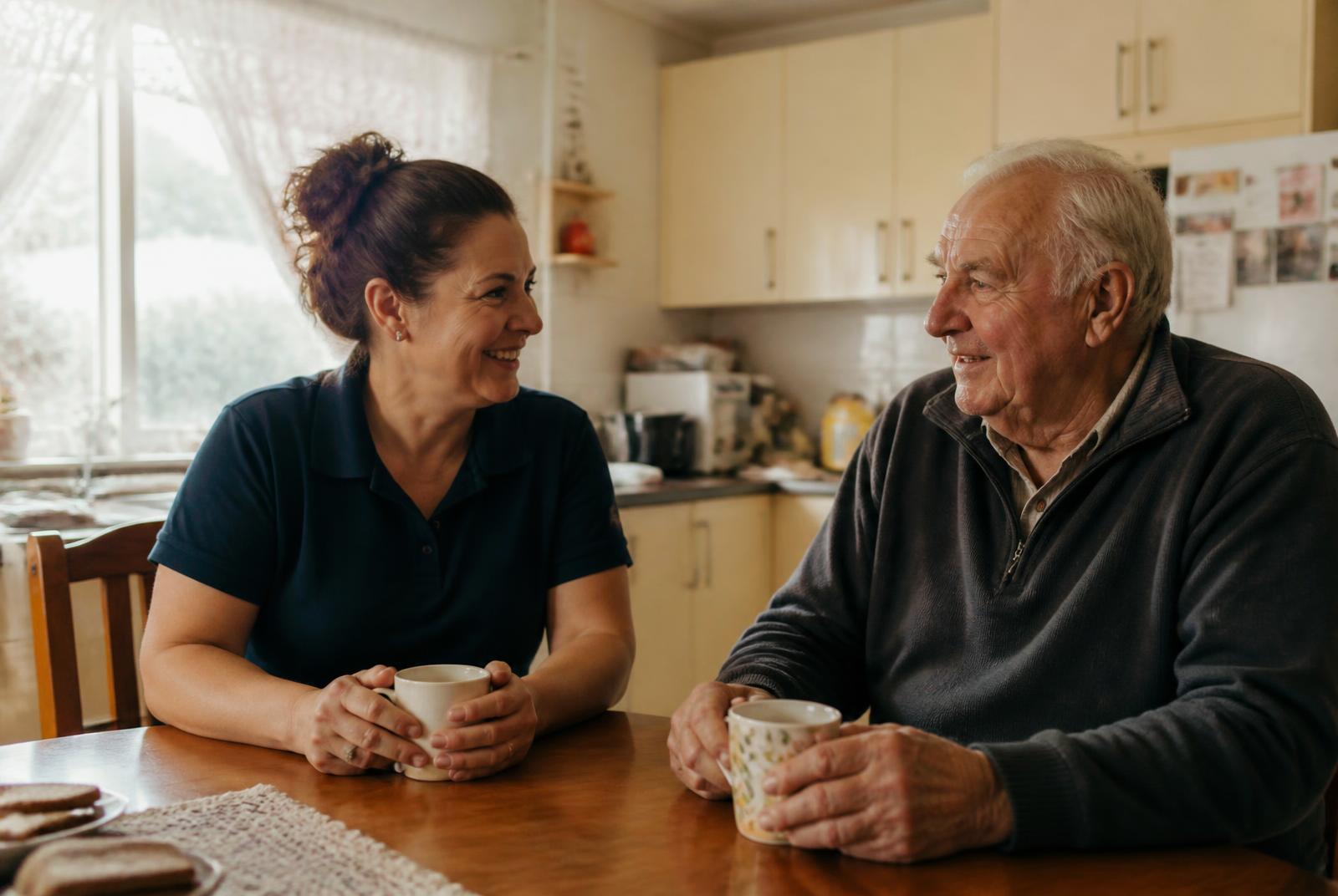
The same record, read from two very different chairs.
A coordinator is watching a roster and a budget. The person receiving care is watching whether the same face turns up, and whether the statement makes sense. Konetic One is built to answer both from the one record.
A coordinator who can see the whole week before it happens
Rostering, budgets, price caps and Quality Standards evidence sit against the same client record, so a coordinator can see a gap forming days before it becomes a missed visit or a shortfall.
- Live budget drawdown by service category, checked against the price cap
- Rosters built around travel time and real minutes, not guesswork
- Standards, SIRS and Quality Indicator evidence tagged as it is created

A statement that matches the visits that actually happened
Family members, often at a distance, can see the week's visits, the budget balance and the next review in a portal, instead of waiting for a phone call or a paper statement that arrives weeks late.
- Visit history, care plan goals and statements visible in one portal
- The same face rostered where preference and continuity matter
- A plain language answer to any statement question, not a call centre queue
Seven service lines, each carried by a named part of the platform.
Home and community aged care is rarely one service. It is personal care, domestic assistance, nursing, allied health, respite, social support and the care management that holds the whole plan together, often for the same person in the same week.
Personal care
Showering, dressing, mobility support and continence care, delivered with dignity and to a plan agreed with the person.
Visit capture against the care plan task list
Visit history mapped to Standard 3, care and services
Domestic assistance
Cleaning, laundry and meal preparation that keep a person safely and comfortably in their own home.
Task lists and time recorded per visit
Service delivery evidence for the everyday living budget category
Nursing
Wound care, medication support, continence management and clinical monitoring in the home.
Clinical record shared with personal care and allied health
Clinical notes evidencing Standard 5, clinical care
Allied health and therapy
Physiotherapy, occupational therapy, podiatry and dietetics working towards restorative goals.
Goals and outcomes linked to the care plan
Progress against restorative goals, reviewed on schedule
Respite
Planned and emergency respite that gives a family carer a break without losing continuity of care.
Roster and handover notes for the replacement worker
Respite utilisation against the client's approved allocation
Social support and community access
Group outings, community transport and one to one social visits that keep a person connected.
Program register and transport bookings
Attendance and engagement evidence for Standard 7
Care management
The ongoing coordination, review and adjustment of a client's whole support plan across every service line.
Care management dashboard
Review currency and goal progress across the whole plan
From assessment to statement, the ledger that never has to be rebuilt.
An hour explains a visit. A month explains a budget. Walk from the day the service agreement is signed to the day the statement lands in a family's inbox, and see what the platform is doing at every step.
- Day 1
Assessment result and service agreement signed
A Support at Home classification or CHSP referral arrives from the national assessment system, and the service agreement, budget category and starting goals are set up against the client record the same day.
Service agreements and intake - Day 2 to 27
Visits accrue against the budget, week by week
Personal care, domestic assistance, nursing, allied health, respite and social support visits are logged from the field and drawn down against the relevant service category budget as they happen.
Visit capture and budgets - Day 20
Care management review
A care manager reviews the month's visits against the client's goals, checks the budget trajectory, and adjusts the coming month's plan before anything runs short or lapses unused.
Care management dashboard - Day 28
Price cap and utilisation check
Every claimed line is checked against the published price cap for its service category, and any category tracking to an unspent or overspent position is flagged to the coordinator.
Budget and price cap engine - Day 30
Quarterly claim submitted
Where the month closes a quarter, the claim to the Department is generated from the same ledger as every client statement, so the two numbers are never in conflict.
Claiming - Day 30
Monthly statement issued to the client
The client and their family receive a statement itemising every service delivered, its cost, the budget balance and any unspent funds carried forward, matching the provider's own ledger exactly.
Client portal and statements

Behind every care minute is somebody's mother, and behind every line on a statement is a visit somebody actually made.
Every obligation, and the evidence Konetic One produces for it.
Support at Home budgets, CHSP acquittals, the strengthened Quality Standards, SIRS, the Quality Indicator Program, and AN-ACC where a provider also runs residential care. Open any one to see what the platform holds against it.
Budgets are held by service category, clinical care, independence, allied health and everyday living, each with its own unit price and drawdown, replacing a single combined package total.
A quarterly claim that reconciles line for line against the client's own monthly statement.
Service volume, unit counts and client contributions are recorded against the grant activity, alongside any clients already transitioned to Support at Home.
A grant acquittal reconciled to actual units delivered, client by client.
Statements are generated from the same visit and claim ledger the provider works from, checked against the published price cap for each service category before it is issued.
A statement history the client and their family can see in the portal, matching the provider's own ledger exactly.
Care plan reviews, complaints, incidents, food and nutrition and lifestyle evidence are tagged to the relevant Standard as they are created.
A self assessment and an accreditation evidence pack drawn from the live record, not assembled for a visit.
The reportable incident workflow classifies priority and starts the 24 hour or 30 day notification clock the moment the incident is opened.
A notification history with immediate actions, family contact and Commission submission timestamped.
Indicator data is captured at the point of care, in the visit note or the clinical chart, and rolled up automatically each quarter.
A Quality Indicator Program return built from daily practice, not a separate quarterly data collection exercise.
Resident classification sets a facility care minutes target, reconciled continuously against worked minutes from time and attendance.
A Quarterly Financial Report figure that matches the shift level ledger behind it.
Every visit is a number of minutes and a number of dollars, before it is anything else.
A roster looks compliant on paper while travel time, cancellations and short visits quietly erode the margin on every run. Konetic One prices a run the way it is actually delivered.

Minutes, not just visits
Every visit logs actual minutes delivered against the rostered plan, so a coordinator can see the difference between a scheduled hour and the forty five minutes a client actually received.
Travel and cost to serve, priced honestly
Travel time and kilometres between visits are costed into the run, so remote and outer suburban delivery is planned with its real cost visible, not discovered at the end of the financial year.
A margin the finance team can see mid month
Cost to serve rolled up by client, by run and by service category gives finance the same picture a care manager sees, weeks before the quarter closes around it.
One capability, doing concrete things across the day and the month.
Ruby is the one named AI capability in Konetic One. In home and community aged care it stays close to the visit and the budget, never the clinical judgement.
Drafts the visit note, the worker checks it
After a personal care or domestic assistance visit, the worker speaks for thirty seconds. Ruby drafts the progress note against the goals in the care plan and leaves every word editable before it saves.
Flags a budget before it runs dry
Ruby reads each client's drawdown against their individual budget and the time left in the period, and flags the ones on track to run out or breach a price cap while there is still time to adjust the roster.
Answers a family's question about the statement
Ruby explains a line on a monthly statement in plain words, in the portal, with the visit it relates to linked, so a coordinator is not the only person who can answer it.
A dose, a refusal and a PRN outcome are all part of the same story.
Whether delivered in a home or a residential unit, medication administration has to be signed at the point of care, not reconstructed later.

- Doses signed at the client, with refusals and withheld doses captured in the moment.
- Restrictive practice use checked against a current authorisation and behaviour support plan before it can be logged.
- Medication reviews from a visiting pharmacist or GP flow back into the chart with a clear effective date.
- Missed or delayed doses raise an alert to the care manager the same day, not at the next review.
The operating detail behind each obligation.
Each deep dive goes further into a single regulatory or operational thread than a hub page can, with the tables, timeframes and platform detail a specialist reader needs.
Care minutes and 24/7 RN
The mandatory care minutes target and the 24 hour registered nurse responsibility are enforced quarter by quarter, but the shortfall is created shif…
Read the deep diveAN-ACC classification and funding
AN-ACC replaced the old funding instrument with a classification set by an independent assessor rather than the provider, which means funding now mo…
Read the deep diveSIRS incident reporting
The Serious Incident Response Scheme runs on two clocks, twenty four hours for the most serious incidents and thirty days for the rest, and both sta…
Read the deep diveSupport at Home transition
Support at Home replaces the Home Care Packages Program and folds in the Commonwealth Home Support Programme on a staged timetable, and providers ar…
Read the deep diveMedication management and eMAR
Standard 5 of the Strengthened Aged Care Quality Standards expects safe and effective medication management to be visible in the daily record, not a…
Read the deep diveAged care platform questions.
Bring one client's real week, and we will map it hour by hour.
Bring a service agreement, a roster and a Support at Home or CHSP budget. We will show where each one lives in Konetic One, and what the statement looks like at the end of it.

A telehealth review with a GP, an overnight call from a family member interstate, and a quarterly claim submission are all part of the same client, and all built into the same record in Konetic One.